
The Choking Dilemma: How Geopolitical Policy, GDP Realities, and Guideline Conflicts Impact Emergency Dental Care
Posted Jul 23, 2026
Dr Hussain Ahmad
SHORT DESCRIPTION
When standard guidelines contradict each other, what is the right move during an airway emergency? An exploration of the American vs. Australian choking protocols, the struggles of developing nations without local guidelines, and a firsthand look at clinical training realities.
FULL CONTENT
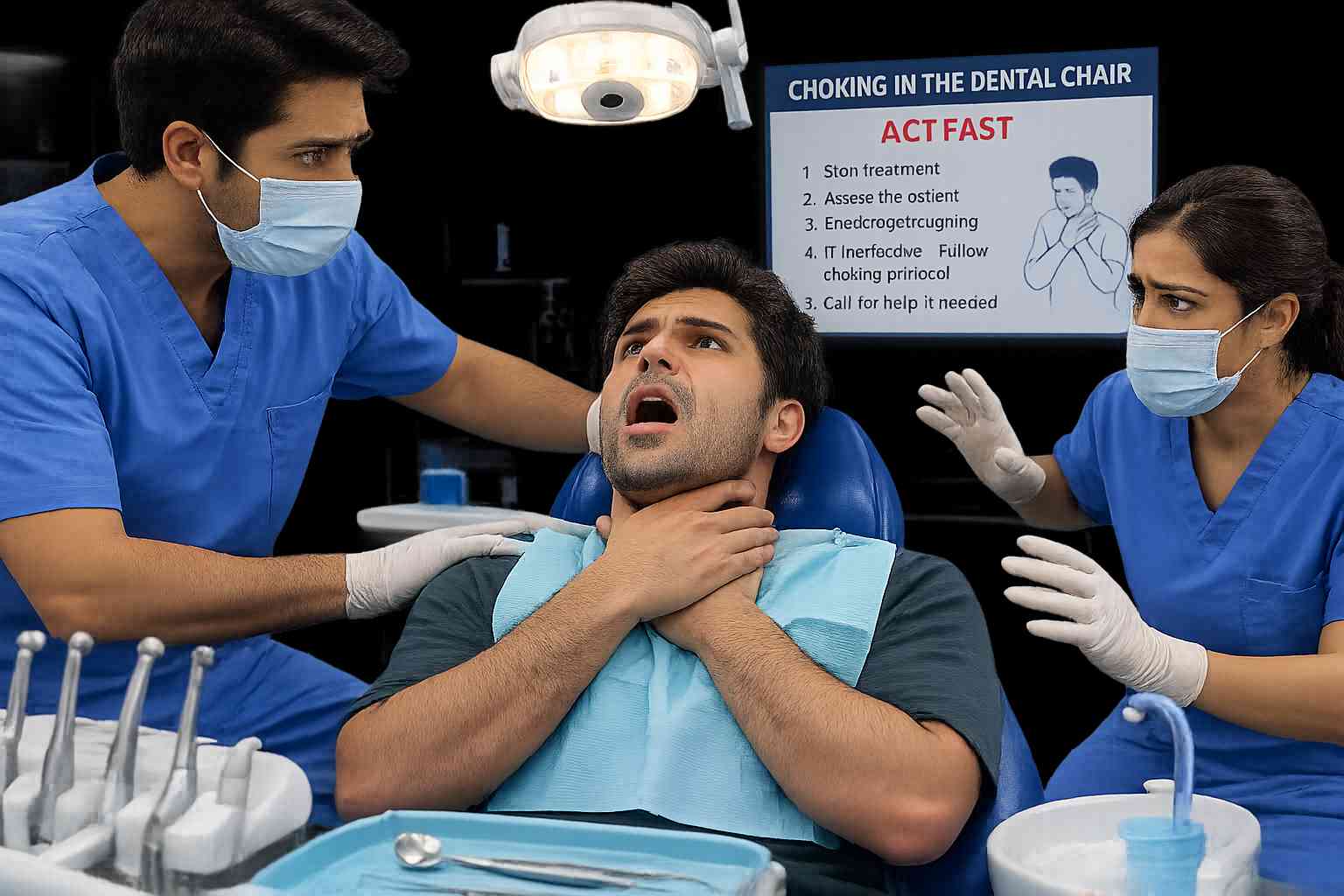
Every dentist knows that an acute airway obstruction in the dental chair is a terrifying, split-second emergency. Whether it's an implant component, a crown, or an endodontic file slipping past the soft palate, immediate action is mandatory. Yet, beneath this universal panic lies a massive geopolitical conflict in medical education: the protocol you perform to save a life depends entirely on which developed country's textbook your nation happened to inherit.
This conflict creates an incredibly frustrating gray zone for dental and medical professionals practicing in developing countries that lack independent, state-funded resuscitation guidelines.
The Classroom Contradiction: A Personal Reflection
This clinical disconnect isn't just theoretical—it plays out directly in our training halls. During a recent Basic Life Support (BLS) workshop at a dental college in Pakistan, the instructor explicitly demonstrated the Heimlich maneuver (abdominal thrusts) as the standard protocol for acute choking. When challenged at the end of the session with the fact that the Australian Dental Therapeutic Guidelines (TG 4) and the Australian Resuscitation Council (ARC) explicitly state that abdominal thrusts are unproven and potentially dangerous due to internal organ trauma, the instructor’s response was simple: "I teach the American guidelines because they are international."
In reality, both the instructor and the questioning student are fundamentally right. The instructor followed the widely distributed, highly marketed American Heart Association (AHA) and American Dental Association (ADA) protocols. The student, on the other hand, was highlighting rigorous evidence-based science from Australia's ANZCOR/ARC frameworks, which mandate 5 back blows followed by 5 chest thrusts, strictly banning the Heimlich maneuver.
The Socioeconomic Root: Why Developing Nations Suffer from "Guideline Anarchy"
Why must a practitioner in South Asia or other developing regions choose between a conflicting American or Australian framework? The answer boils down to macroeconomics and public policy.
Take Pakistan as a primary example: the national expenditure on health and education historically hovers around a staggering 1.6% of the total GDP— for health it is .8 percent ranking as one of the lowest educational and healthcare budgets among all neighboring countries. When a nation's basic funding is stretched thin, there is zero financial surplus left to invest in large-scale, independent clinical trials, epidemiological registries, or specialized resuscitation councils. Without local, data-driven research to prove what works best for a specific population, institutions have no choice but to blindly copy Western guidelines.
The Call for a Unified Global Consensus
When two global research superpowers like the United States and Australia explicitly contradict one another on an emergency maneuver, it leaves underfunded health systems completely vulnerable. One framework conducts massive practical workshops teaching a technique as life-saving, while the other publishes peer-reviewed data warning that the exact same technique can rupture a patient's liver or spleen.
For healthcare systems with minimal research infrastructure, this is more than an academic debate—it is a legal and ethical tightrope. It is high time that global bodies like the World Health Organization (WHO) work alongside the AHA and the ARC to synthesize their data and agree on a unified, definitive protocol. Until that day comes, the best a skilled clinician can do is master the physical mechanics of both philosophies, prioritize strict prevention like rubber dams, and make a calculated clinical decision when a life is on the line.
KEYWORDS
Heimlich maneuver controversy, Australian Resuscitation Council choking, American Heart Association BLS, dental emergency guidelines, healthcare GDP Pakistan, medical research funding, abdominal thrusts vs back blows, dental airway management, global healthcare policy.
Related Dental Blogs
Baby bottle caries : A clinical experience and the importance of patient history
Community Dentistry, Pediatric dentistry
How Dentists and Other Healthcare Professionals Can Apply for MS/PhD Programs in the USA and Europe (Free Resources)
Study Abroad
HOW TO USE AI EFFECTIVELY FOR DENTAL STUDYING
Lessons from Gilgit: Why It’s Time for Dentists to Step Out of the Clinic and into the Community
Community Dentistry